 FanOptik
Features › Creator transparency
One line on this page, she can check without asking you.
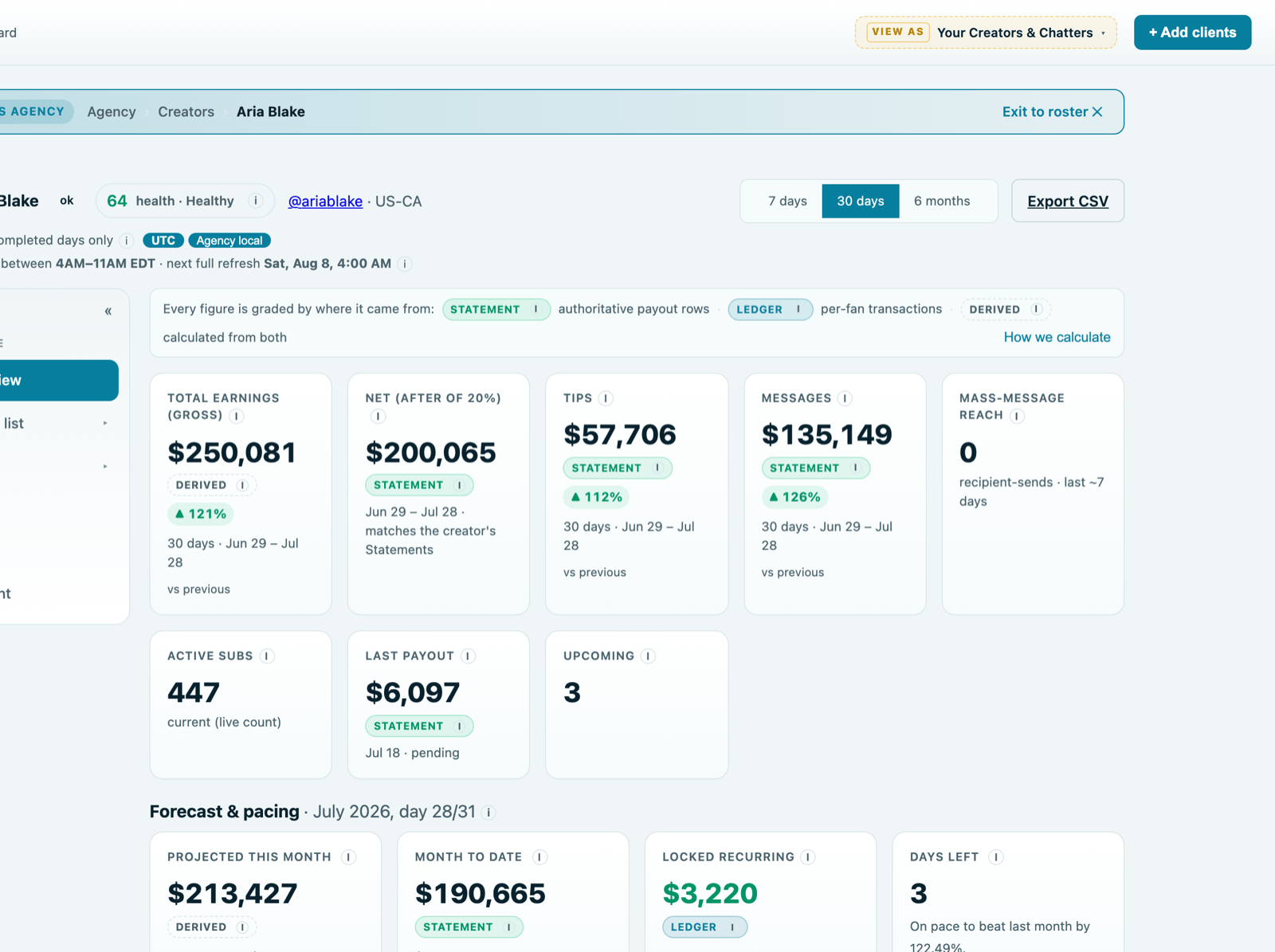
Creators open their own view: coverage, performance, and how the split was computed. Not a screenshot you prepared, and not a friendlier calculation — the same reconciled figures you are looking at, filtered to her account.
The thing that makes it worth anything is that one row of it reconciles to a page you do not control.
Three questions, and what she can check for each one.
A creator asking about her split is almost never asking about arithmetic. She is asking whether anybody was working, whether the number is the real number, and whether the deal is what she thinks it is. Those are three different questions and they need three different answers.
The split, built from the top, with the checkable row marked.
Every argument about a split is really an argument about which number the percentage was applied to. So the percentage is never shown on its own: the whole build is.
The commissionable base is stated, not assumed. This contract is seventy per cent of net, so the percentage is applied to $41,207.55 and to nothing else. An agency computing the same split on gross would arrive at a different answer and could show her a page that looked equally confident — which is exactly why the base is printed rather than implied. Figures are illustrative, from a demonstration workspace.
Coverage, including the hours nobody worked.
The second question is usually the real one. A creator who feels ignored is not going to be talked round by an earnings chart, and a coverage view that only showed the good days would be worth less than nothing.
Saturday is blank, and she can see that it is blank. So can you, in the same view, from the same rota. The conversation that follows is a real one about cover rather than a disagreement about whether the weekend was quiet or unattended — and the same record is what stops revenue from an uncovered hour being credited to somebody who was not there.
Coverage is drawn from clock-ins, which is also where the hours on a chatter’s payslip come from. There is one rota, and every seat reads it.
Illustrative week from a demonstration workspace. An uncovered hour is shown as uncovered; it is never smoothed into an average, for the same reason an absent figure is never drawn as a zero.
What she opens, and what stays yours.
Transparency is not the same as an open roster. Her view is her own business, and it stops there.
- Her own earnings, reconciledNet matched to her Statements page, with the grade shown on the figure.
- Whether somebody was on shiftThe coverage view above, including the gaps.
- How the split was computedThe build above, on her own numbers, for any period she chooses.
- Her payout historyWhat was paid and when, as the platform recorded it.
- The fan data policy, in plain EnglishWritten so she can publish it to her own audience under her own brand.
- Any other creator’s accountNot earnings, not names, not totals, not a roster average she could be ranked against.
- Your chatters’ payRates, hours and commission stay inside the agency seats.
- Which named person covered herCoverage is shown as hours, not as a staff rota she could hire from.
- Your costs or your marginWhat the software costs you and what you make is your business, not hers.
- Fan identitiesThe same rule as every other seat: no handles are shown to anybody in the product.
This does not make your split fair. It makes it legible.
If your rate is high, she will now be able to see exactly how high, on a page you cannot edit, against a figure you cannot move. That is the deal. This only works as a trust instrument if it also works when the answer is uncomfortable, and a version that quietly rounded in your favour would be worth nothing to either of you.
It does not arbitrate your contract either. What the split should be is a commercial negotiation between two adults. All this does is make sure you are both negotiating about the same numbers, which turns out to be most of the argument.
Agencies who have run it report the same thing: the number of split conversations does not go down, but they get shorter, and they stop being about whether anybody is being lied to.
How her figures are made
Her earnings reconcile to her own Statements page — the platform’s record, and the one page in this arrangement you have no control over. That is what makes the figure checkable rather than merely presented.
The platform’s own cut is shown as its own line. The commissionable base is stated rather than assumed, so a rate is never quietly applied to the wrong number.
Her view is the same ledger as yours, filtered — not a separate calculation that could drift apart from it. Coverage comes from the same clock-ins that produce a chatter’s payslip hours. Full rules on the methodology page.
What this does not do
- It does not make your split fair. It makes it legible, including when that is awkward for you.
- It does not arbitrate your contract. The rate is a negotiation; this only ensures you are both looking at the same figures.
- It does not show her the roster. Her account, and nothing else on it.
- It does not name who covered her. Hours, not a staff list.
- It will not save a bad relationship. If the numbers are the problem, showing them clearly brings the conversation forward rather than preventing it. Several agencies consider that the feature.
The conversation this changes.
FanOptik for creatorsThe same view, written from the other side of the table.Open
Roster analyticsThe ledger her view is filtered from, and the grade on every figure in it.Open
How fan data is handledWritten so a creator can publish it under her own brand.Read
Answer the question before it is asked.
A 20 minute walkthrough, then 14 days on your real roster. Show one creator her own view and watch what it does to the next conversation.
Analytics and chatting for OnlyFans agencies and independent creators. Measured across the whole roster, with every figure graded by where it came from.
Free tools
API
Methodology
Security
System status
References
Disclosure
How fan data is handled
Privacy policy
Terms of service
© 2026 FanOptik. All rights reserved. · Built for agencies that would rather measure the roster than estimate it.